On April 7, 2026, the Center for E-commerce and Digital Technology Development (eComDX) - Department of E-commerce and Digital Economy, Ministry of Industry and Trade, collaborated with FPT College to organize a talk show titled “KOC and the Rules of the Game in E-commerce” for e-commerce students at the Hanoi campus and other campuses nationwide.
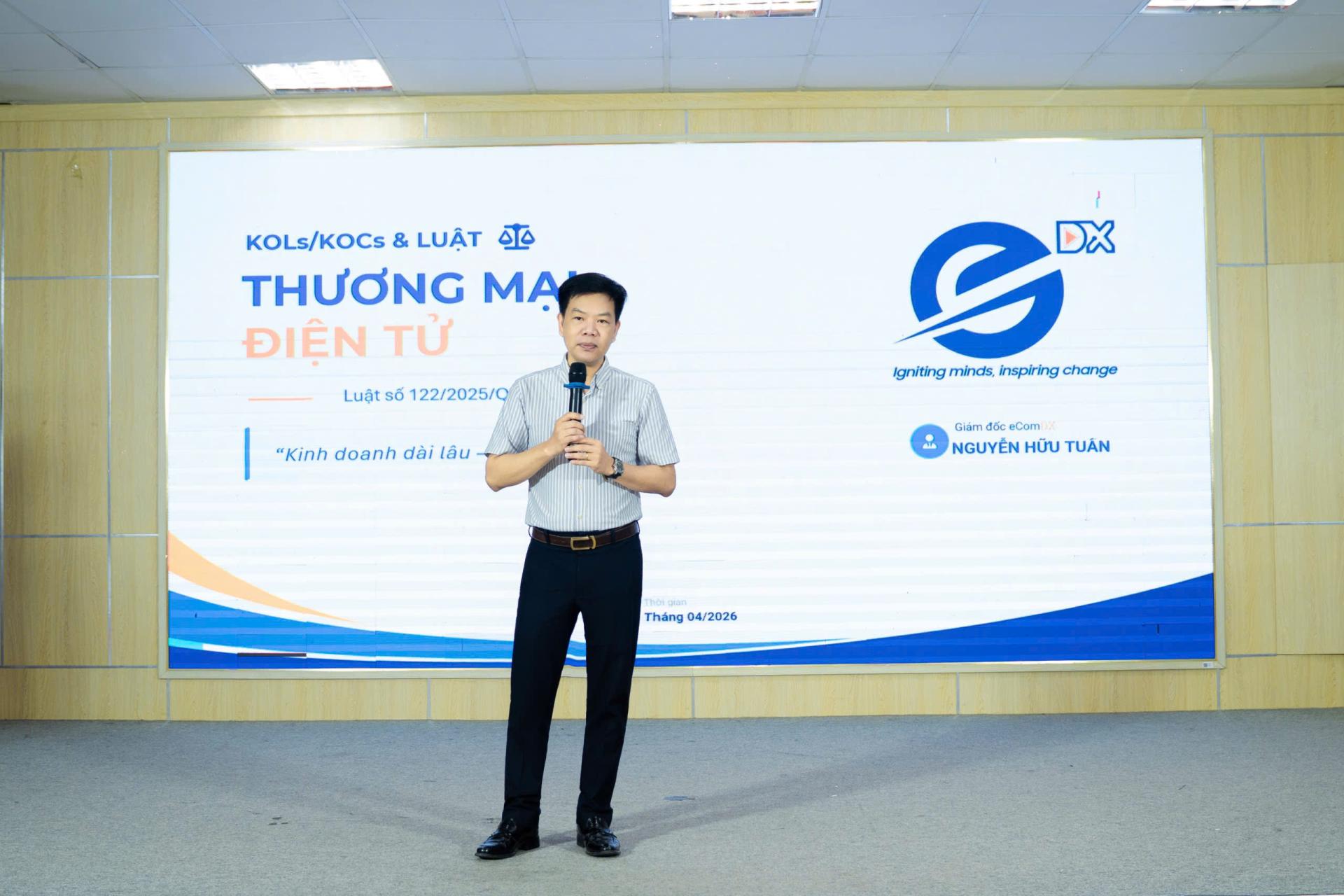
Mr. Nguyen Huu Tuan - Director of eComDX, presented at the TalkShow.
At the talk show, Mr. Nguyen Huu Tuan - Director of eComDX - guided students to better understand the changes in the 2025 E-commerce Law; raise awareness of legal compliance in e-commerce from the stage of selecting eligible products for business, thereby helping with appropriate communication and promotion; learn about regulations on seller identification, livestream management, and tax obligations; declare revenue correctly for individual businesses and KOCs doing Affiliate marketing, thereby alleviating concerns about legal and tax issues, helping participants confidently do business…

Photo: The talk show attracted a large number of students participating both in person and online at multiple locations across the country.
The talk show took place in an open atmosphere, with lively exchanges and discussions between experts from the Department of E-commerce and Digital Economy, and a large number of students participating both in person and online at various locations nationwide. This shows that, in their journey of starting a business with e-commerce, issues related to the upcoming E-commerce Law are receiving great attention from the younger generation, aiming for professional, systematic, and legally compliant online business practices.
New legal framework: "Long-term business success starts with the law"
On December 10, 2025, at the 10th session of the 15th National Assembly, the Law on E-commerce was passed. The law will take effect from July 1, 2026. The Law on E-commerce consists of 7 chapters and 41 articles, built in a logical manner, comprehensively covering all entities, models, and activities of e-commerce, while ensuring the interconnectedness between market development and state management.
In the context of Vietnam's booming e-commerce market, the enactment of Law No. 122/2025/QH15 on E-commerce (referred to as the 2025 E-commerce Law) is not only a necessary step to manage the market but also a foundation for protecting the rights of participating parties. According to Mr. Tuan, “For the first time, e-commerce has its own law instead of a decree, creating a solid legal basis to protect consumers, promote online exports, and expand the market for Vietnamese goods. The contents of the 2025 E-commerce Law are consistent with the trend of the digital economy and international trade commitments, creating a level playing field and applying uniformly to both domestic businesses and cross-border platforms; at the same time, it effectively controls livestreaming sales and affiliate marketing in the domestic market . ”

Photo: Sharing practical experiences from Ms. Thu Hoa - CEO of Truong Foods and Mr. Nguyen Huu Tuan - Director of eComDX.
Mr. Tuan stated, "Long-term business starts with the law." Accordingly, it is necessary to note several prohibited acts in e-commerce as stipulated in the 2025 E-commerce Law, such as: Fraud and deception of consumers; Intellectual property infringement; Expired goods; Aiding and abetting violations; Trading in prohibited or counterfeit goods; Smuggled goods of unknown origin; Violations of product quality standards; Providing false information, etc.
According to experts from the Department of E-commerce and Digital Economy, one of the key highlights of the 2025 E-commerce Law is the regulation of digital marketing methods, adding provisions on livestreaming sales and affiliate marketing. These are entirely new provisions aimed at filling previous legal gaps. With the rise of the Key Opinion Consumer (KOC) profession, the new regulations focus on honesty and accountability.
Specifically, individuals conducting live stream sales or advertising on these platforms must undergo identity verification (KYC). This aims to prevent counterfeit and fake goods from being sold through fake accounts.
Affiliate marketers (known as Publishers) are no longer simply "referrers" but must register their information with the platform, fully comply with legal regulations on advertising and consumer protection, and are directly responsible for the accuracy of the product information they promote. Advertising counterfeit goods, making false claims, or exaggerating product benefits will be severely punished.
The era of professional business and the rule of law.
Taxation is always a central focus in new regulations. The E-commerce Law 2025, along with related tax laws, has established a comprehensive system for managing income from cyberspace.
According to the new regulations, e-commerce platforms (such as Shopee, TikTok Shop, etc.) are responsible for declaring and paying taxes on behalf of individual businesses operating on their platforms. This helps minimize tax evasion and simplifies procedures for small-scale businesses.

Regarding the use of personal identification numbers as tax identification numbers, Mr. Tuan informed that from July 1, 2025, using personal identification numbers instead of tax identification numbers will help management agencies easily access individuals' income from various sources in the digital environment.
During the talk show, the Director of eComDX linked real-world case studies from specific businesses to solve illustrative problems related to taxation. Specifically, the examples provided, such as how affiliate marketers declare and pay taxes, helped students better understand how taxes are calculated in e-commerce in a concrete and clear manner.
The changes to the 2025 E-commerce Law indicate that the era of "spontaneous business" on social media is gradually coming to an end, giving way to an era of professional business and respect for the law.
Based on insights into the new provisions of the 2025 E-commerce Law and regulations on seller identification, livestream management, and tax obligations, Mr. Tuan offered advice to livestream sellers. Emphasizing the motto "Long-term business starts with the law," Mr. Tuan suggested that individuals and businesses need to update their legal knowledge to understand regulations on advertising and intellectual property, thereby avoiding unnecessary violations. He advised registering a personal business tax code from the outset; using a separate bank account for business operations; maintaining complete records of input documents (electronic invoices) to prove the origin and legitimacy of expenses; and proactively reviewing data on the "eTax Mobile" app.

Photo: Speakers and teachers from FPT College taking a commemorative photo with representatives of the participating students.
During the Q&A session, many insightful and practical questions were raised by students, such as: "How to achieve sustainable business?", "What are the simplest steps to start a business that is both legally compliant and sustainable in the long run?", "How to compete when competitors are circumventing the law to sell at low prices?", "Should we build a personal brand or a product?", "What are the new points of the E-commerce Law and its impact on Gen Z when doing online business or becoming a Key Opinion Leader in the future?", etc. The speakers shared and answered these questions thoroughly, giving young people a deeper understanding of their chosen profession and career development directions. In particular, there was a sharing of entrepreneurial experience from Ms. Nguyen Thi Thu Hoa - female founder and CEO of Truong Foods (Top 20 Outstanding Young Vietnamese in 2022).
The Director of eComDX emphasized that the 2025 E-commerce Law is being developed with a focus on fostering development, enhancing management efficiency, and protecting the legitimate interests of businesses and consumers, with several new and prominent provisions. Effective from July 1, 2026, the 2025 E-commerce Law will create a healthy playing field for legitimate businesses, protect consumers, and promote the sustainable development of Vietnam's digital economy, reaching international standards.